Creating Resort-Style Ambiance with Bistro String Lighting in Phoenix

February 23, 2026

Transform Your Backyard Into a Resort Retreat


Resort evenings do not have to wait for a vacation. With the right lighting, your own backyard in Phoenix can feel like that favorite courtyard, rooftop patio, or pool bar you never want to leave. Bistro string lighting has a simple job, but it does it very well: it makes outdoor spaces feel special.


Soft, warm light overhead changes how a patio or pool area feels in an instant. Hard concrete looks softer, water glows, and simple furniture looks stylish. Friends tend to stay a little longer and conversations feel a little easier under a canopy of small, warm lights.


As an outdoor lighting company in the Phoenix area, we work with bistro string lighting every day. When it is planned and installed the right way, it turns ordinary yards into relaxing retreat spaces that feel a lot like a resort, just without the travel or nightly fees.


Why Bistro String Lighting Feels Like a Desert Resort


There is something about bistro string lighting that makes people relax. The light is gentle and warm, so faces look good and colors feel rich, not washed out. Instead of one bright glare from above, the glow is spread across the space, which invites people to slow down and stay awhile.


This style of lighting reminds many people of:


  • Desert resorts with cozy courtyards 
  • Rooftop lounges with soft music and long tables 
  • Small cafes with hanging lights over patios 


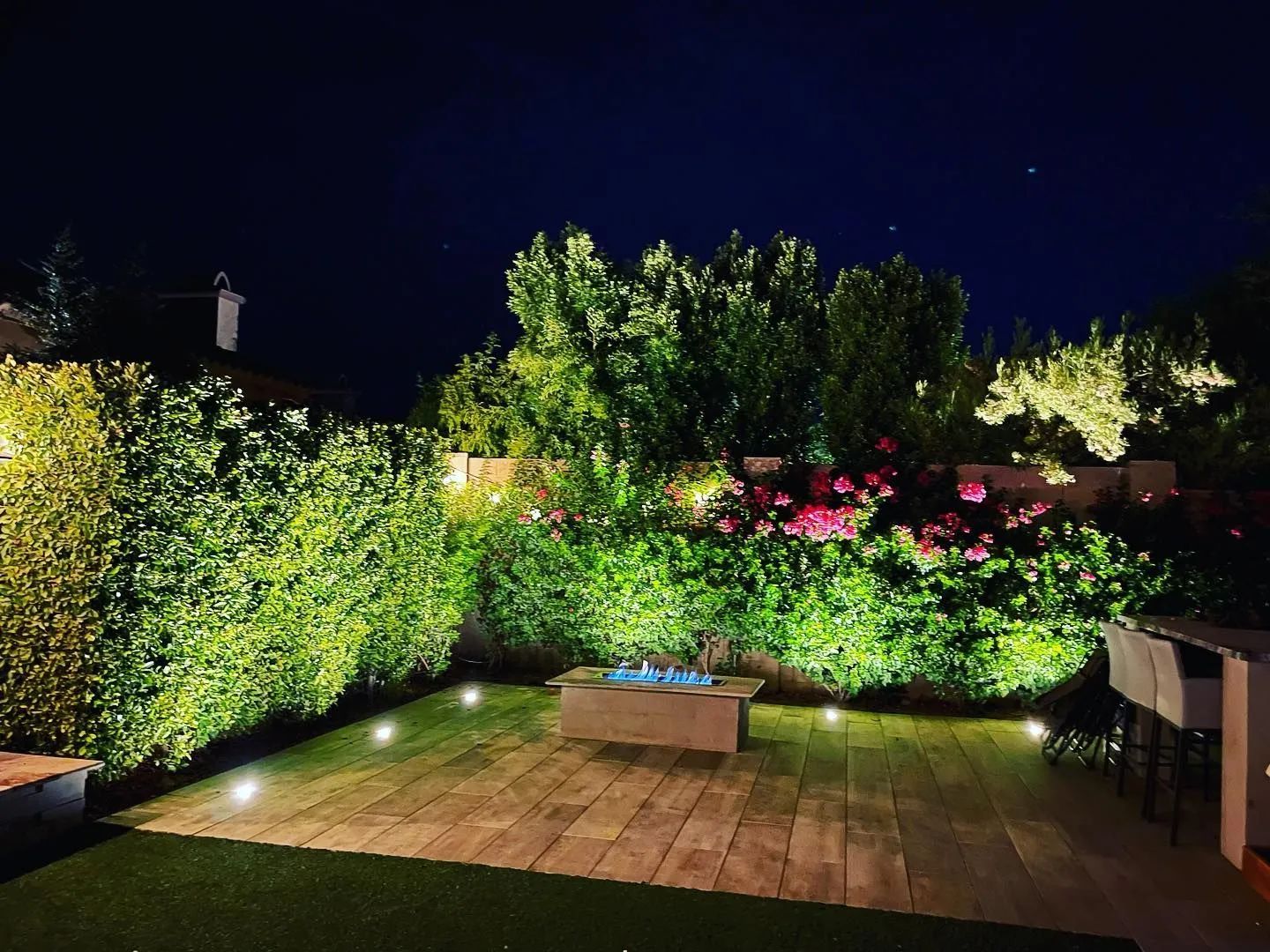
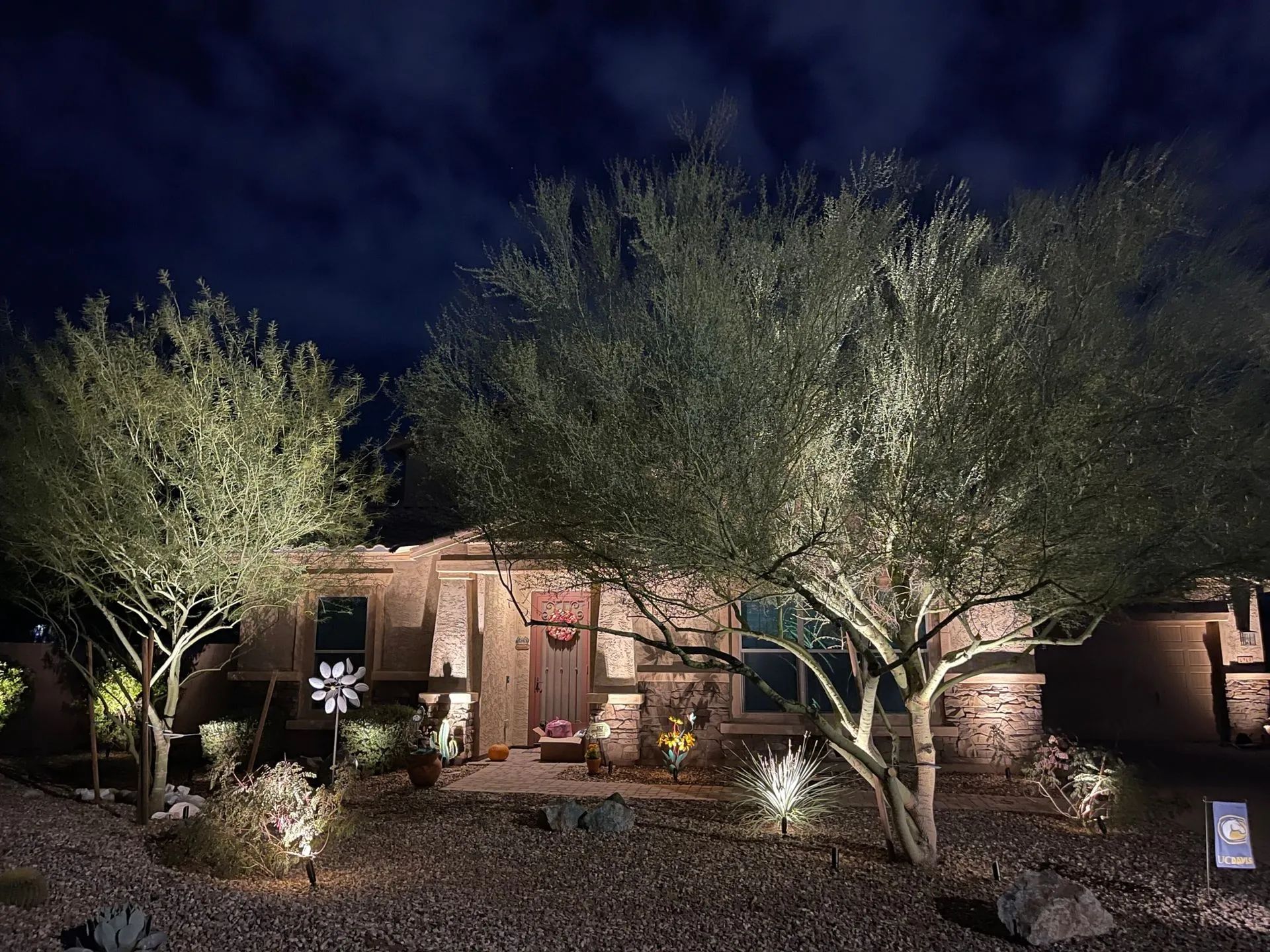
That same feeling works perfectly in Phoenix backyards. The warm light softens stucco walls and shows off texture in stone, brick, and wood. Desert plants like agave, yucca, and tall cacti catch the light in interesting ways, so your landscaping has depth even after dark.


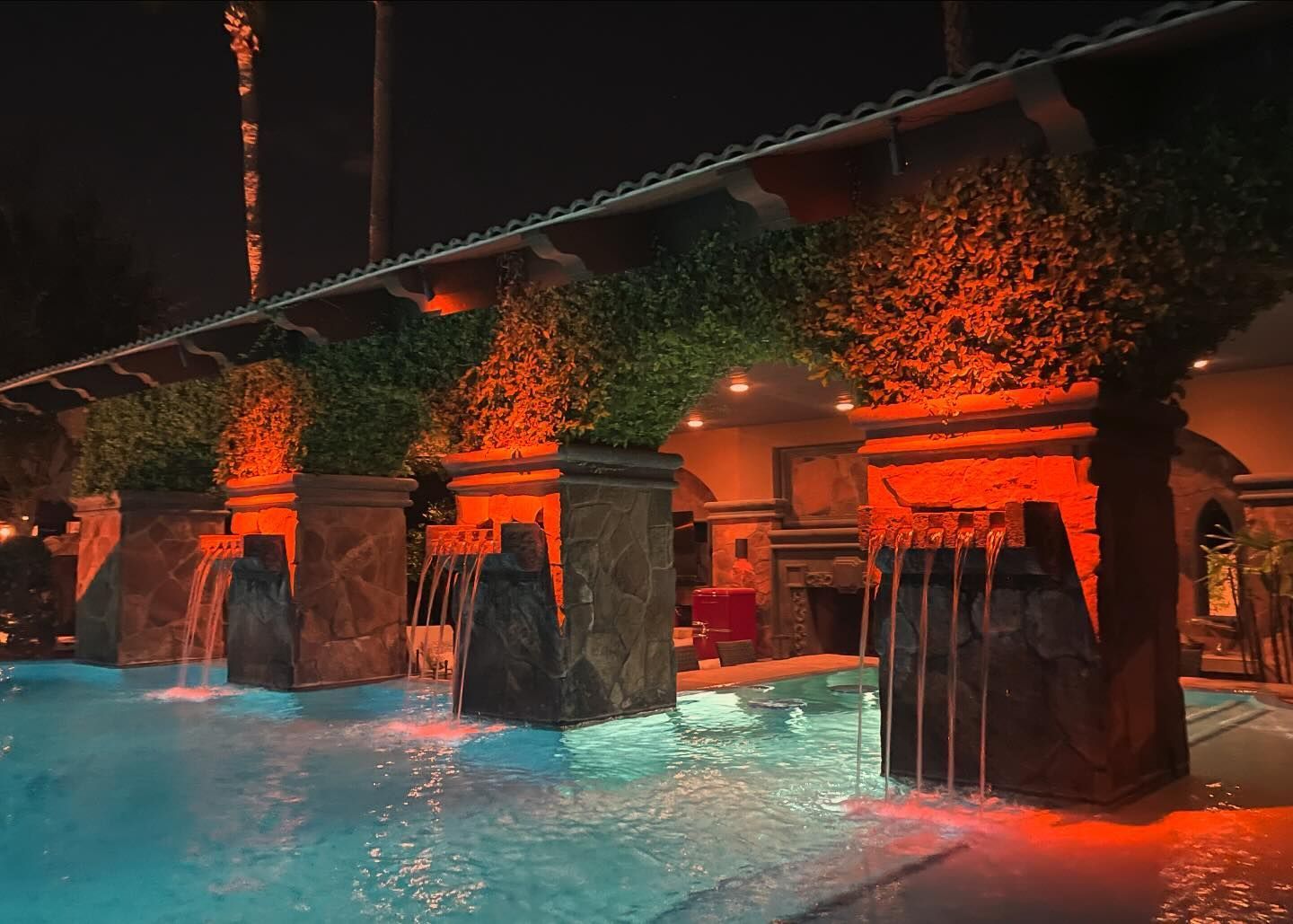
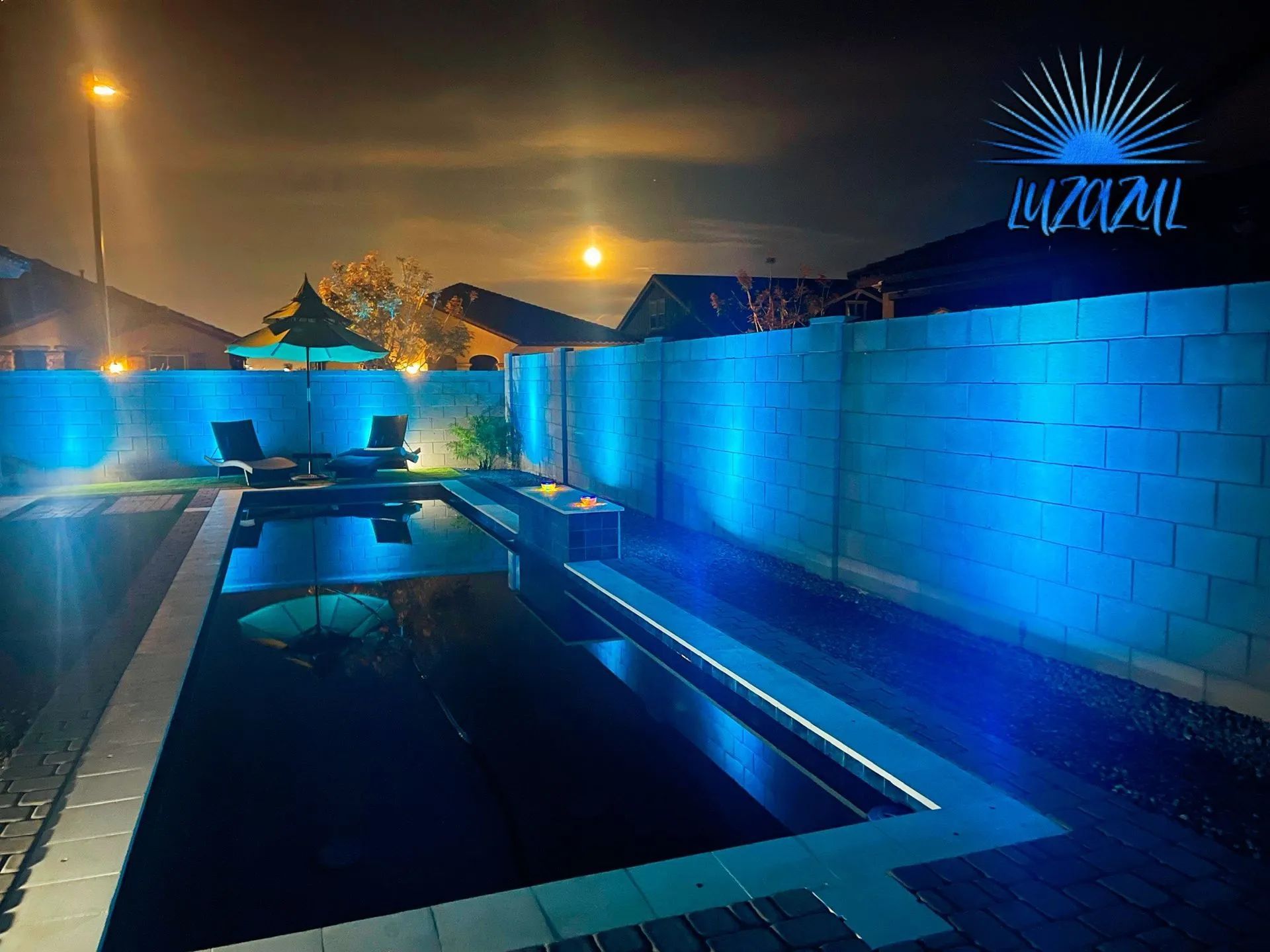
Around pools and water features, bistro lights reflect off the surface and create a gentle sparkle. Paired with the clean lines of modern pavers or the curves of a freeform pool, the result feels upscale and relaxed at the same time. The space stops feeling like just a yard and starts feeling like the outdoor lounge at a boutique hotel.


Designing Bistro String Lighting for Phoenix Backyards


Good resort-style lighting is never random. The layout is what turns simple string lights into something that feels designed and thoughtful. We look at how you actually use your yard, then shape the light around those habits.


Common layouts include:


  • Draped over outdoor dining tables for long dinners 
  • Zig-zag patterns across patios to fill open space with a soft canopy 
  • Perimeter runs around pool decks to frame the water and keep pathways clear 
  • Straight runs that frame views of fireplaces, TVs, or outdoor kitchens 


Phoenix backyards also have some special needs. Sun exposure is a big one. Strong sun can be hard on materials, so we plan the runs to avoid unnecessary strain on cables and connections that will sit in direct light all day. Wind is another factor. Open lots and two-story homes can create wind tunnels, so we design with proper tension and anchoring to keep lines from banging into walls or posts.


Brightness matters too. You want enough light to see steps, food, and faces, but not so much that it feels like a stadium. We pay close attention to:


  • Color temperature, so the light is warm and flattering 
  • Mounting height, which changes how bright the lights feel at eye level 
  • How the string lighting works with any path, wall, or landscape lighting already in place 


Our process usually includes an on-site walkthrough. We look for smart anchor points, like strong posts or structures, and we plan where each line should start and stop. From there, we match the style and warmth of the bistro lights to the rest of your outdoor lighting so everything feels like one complete design, not separate pieces.


Built to Handle Phoenix Heat, Sun, and Storms


The Phoenix climate is tough on outdoor lighting. Off-the-shelf bistro string lights that might work fine in softer climates often fail quickly here. Strong UV light can damage thin insulation and plastic parts. Over time, this can lead to:


  • Brittle, cracked wiring 
  • Discolored or broken sockets 
  • Sagging lines that look messy 


Moisture from sprinklers, irrigation, and the occasional monsoon storm can also find weak points in cheap connections. Corrosion can sneak in around sockets and plugs, which may cause flickering or complete failure.


For a resort-style look that lasts, the materials and installation method really matter. Commercial-grade fixtures are built with thicker insulation that resists UV damage. Quality sockets grip the bulbs well and help keep water out. Strong, properly tensioned cables support the weight of the lights so they stay straight and neat.


We focus on craftsmanship during installation. That means:


  • Using professional-grade cables and hardware suited to long spans 
  • Tensioning the lines correctly so they do not sag over time 
  • Securing mounts into solid structure instead of weak trim or thin material 
  • Planning routes so the lights are protected from spray and standing water 


When the install is solid, you get more than just good looks. You get a system that is safer, more reliable, and ready for years of Phoenix sun and seasonal storms.


Setting the Mood for Spring and Summer Entertaining


Late February is when many Phoenix homeowners start thinking more about outdoor time. Spring training games, school events, and pool season are close. Even on busy weeks, evenings can be the best time to relax outside with family or friends.


Bistro string lighting stretches the usable hours in your yard. Once the sun goes down, you can still:


  • Host relaxed al fresco dinners on the patio 
  • Set up game nights around a big table or outdoor bar 
  • Celebrate birthdays, graduations, and holidays without moving inside early 


When we design bistro string lighting, we often pair it with other outdoor systems for a full resort feel. Soft path lighting helps guests move safely between the house, pool, and seating areas. Architectural lighting on walls or columns adds depth and interest. Around pools, core drill lighting in the hardscape can create a clear edge and a gentle glow near the water.


Outdoor audio can also complete the experience. When the lighting and sound work together, the whole space feels intentional and relaxed, like your own small resort waiting just outside your back door.


Bringing Resort-Style Lighting Home with Luzazul Lighting


A well-lit backyard changes how you use your home. Instead of only stepping outside during the day, you get a space that feels just as inviting at night. Bistro string lighting that is designed for your yard can raise both daily enjoyment and the way people see your property.


At Luzazul Lighting, we focus on custom outdoor lighting and audio designs for Phoenix-area homes, including bistro string lighting, path lighting, architectural lighting, and core drill lighting. We walk each property, listen to how the space is used, and then create a plan that fits the layout, the style of the home, and the local climate.


When bistro string lighting is planned with care and built for desert conditions, your backyard starts to feel less like a simple yard and more like a private resort. All you have to do is step outside, flip a switch, and enjoy the glow.


Transform Your Outdoor Evenings With Custom Bistro Lighting


Bring warmth and character to your patio, backyard, or commercial space with our professionally designed bistro string lighting in Phoenix. At Luzazul Lighting, we listen to your vision and create a lighting plan that feels inviting, functional, and tailored to your property. If you are ready to explore design options or get a quote, contact us and we will help you plan the ideal setup. Let us handle everything from design to installation so you can enjoy beautifully lit evenings with zero hassle.

By Dennis Lozano August 18, 2026
12 Desert Landscape Lighting Ideas for Phoenix Yards Most outdoor lighting advice is written for somewhere else. Lush green lawns, towering oaks, dense shrubs that absorb light the way a thick blanket absorbs sound. Phoenix yards play by completely different rules. The best outdoor lighting ideas for desert landscaping in Phoenix start with plant profiles and the local palette, warm ochre, silver-green, and soft gray, before a single fixture enters the conversation. The plants cast sculptural shadows. Gravel reflects light in ways grass never does, and a saguaro at night is one of the most striking natural forms you can illuminate, if you know how. Light the desert wrong and you wash it out. Paths turn into runways. Cacti look like glowing green lamps. The entire yard loses the texture that makes it worth looking at. Light it right and the yard reads like the Sonoran at golden hour, preserved well past sunset. Companies that work exclusively in the Phoenix desert, like the team at Luzazul Lighting, approach each project with plant profiles and the local palette in mind first and fixtures second. That order of priorities matters more than most homeowners realize. What follows covers specific techniques for saguaros, agaves, gravel paths, and xeriscaping, along with the fixture specs, color temps, and zoning logic that hold it all together through 115-degree summers. Why Phoenix desert yards need their own lighting philosophy Decomposed granite, pale stucco, and open gravel reflect light significantly more than dense green landscaping. A fixture that works fine in a turf-heavy Midwest backyard can blow out a desert yard entirely. The goal that every decision in this guide works toward is "moonrise over the desert," not "parking lot." That framing changes which fixtures you buy, where you place them, and how many lumens you actually need. Phoenix city code requires shielded or filtered lamps. Unshielded fixtures must shut off between 11 p.m. and sunrise. In unincorporated Maricopa County, outdoor lights must be fully shielded and directed below the horizontal plane to operate through the night; unshielded fixtures under 1,000 candelas are permitted only if they shut off between midnight and sunrise. Maricopa County also caps color temperature at 3,000K for residential landscape and security lighting, and limits fixtures to 1,600 lumens unless fully shielded. HOA rules layer on top of all of this and are often stricter, so read your CC&Rs before you buy a single fixture. The smartest desert lighting plans organize the yard into three zones first: ambiance (accent and uplighting on plants and features), navigation (paths, steps, and entries), and security (perimeter, motion-activated). Fixtures follow zone logic. Designing zone by zone prevents the most common mistake in desert lighting, which is scattering fixtures wherever something looks interesting and ending up with no coherent nighttime scene at all. Outdoor lighting ideas for desert landscaping in Phoenix: uplighting saguaros, agaves, and other signature plants A saguaro rewards precision. Use a narrow beam in the 10 to 24 degree range and place the fixture 6 to 10 feet from the base rather than tight against it. Setback matters because it lets the beam reach the full height of the plant instead of flattening the light on the lower trunk. Angle the fixture to graze the ribs rather than flood the column. Grazing reveals texture. Flooding creates a washed-out green pillar. For a mature saguaro, three uplights spaced around the base create natural cross-shadows from the arms. One fixture placed directly beneath the cactus produces a flat, theatrical look that reads false. Shift each fixture slightly off-center so the arm silhouettes read clearly against a dark sky. 2700K is the right color temperature here : warm and natural against the muted gray-green of a mature saguaro without tipping it into stage-prop territory. Agaves respond well to a single low-wattage uplight aimed at the rosette from one side, creating directional shadow that emphasizes the leaf geometry. Two fixtures aimed from opposite sides cancel each other out and flatten the plant. Ocotillos are often better silhouetted than uplighted: a ground-mounted fixture behind the plant, aimed at a wall or fence, drops the spiny branches into dramatic shadow. Prickly pear benefits from grazing light from the side to catch the texture of the pads; a warm 2700K path light placed low and close often works better than a dedicated uplight at this scale. For color temperature, 2700K gives the warmer, more atmospheric desert-at-night look on most plants. 3000K is worth considering on agaves specifically, because it better preserves their cool blue-green or silvery character and shows leaf structure more clearly. Color temperatures above 3000K produce a cooler, more clinical look against earth-tone desert landscapes and tend to work against the natural character of saguaros and prickly pear. Phoenix landscape lighting ideas for gravel paths and xeriscaping Decomposed granite reflects significantly more light than turf. Path fixtures that work fine on a grass-bordered walkway can create a glare runway on DG. Keep output low, typically 30 to 50 lumens per path light rather than the 100-plus common in lawn-based landscapes. Spacing of 6 to 8 feet works for most residential paths, and you can stretch to 8 to 10 feet on light-colored DG if the path is straight and the gravel is doing some of the work for you. Stagger fixtures on alternating sides of the path rather than lining them up in parallel rows. A single axis of fixtures on a straight gravel path looks like a runway from a distance. Staggered placement creates depth and eliminates that effect. Position fixtures at the edge of the path rather than in the walking surface to protect them from foot traffic and gravel shifting. Steps look best with recessed or surface-mounted step lights aimed downward, not outward. The light should define the edge, not broadcast into the yard. Low-profile bollard lights work for wider paths or courtyard zones, but keep them under 18 inches tall so they contribute to the ground-level palette rather than competing with plant silhouettes above. Large boulders reward a single grazing fixture placed low and tight: the goal is shadow, not illumination. Place the light so it catches the rock's surface texture on one face and lets the other fall dark. Dry riverbeds with cobblestones are best lit from the edge rather than from directly above; the indirect wash creates depth and suggests movement without turning the feature into a spotlight. Fixture materials and specs built for Phoenix heat For Phoenix's combination of extreme ambient heat, intense UV, and virtually no moisture to naturally cool fixtures, material selection is a durability decision above all else. The durability ranking for this climate is solid brass first, 316 stainless steel second, copper third, and high-quality powder-coated aluminum fourth. Brass and copper develop a natural patina that seals the surface over time. Stainless delivers a modern look with strong corrosion resistance. Powder-coated aluminum is the most accessible price point but requires a coating tested to at least AAMA 2604 standards to hold up long-term. Avoid low-cost plastic housings entirely; they become brittle under constant UV and degrade relatively quickly under Phoenix's intense sun. For IP ratings, target IP65 as a minimum for exposed above-ground fixtures and IP67 for anything in-ground or near areas where water can pool. On maximum operating temperature, look for fixtures rated to at least 50 degrees Celsius for standard placements and 80 degrees Celsius or higher for recessed or in-grade applications where the fixture sits surrounded by heat-retaining concrete or compacted stone. For lenses, tempered glass or UV-stabilized polycarbonate outperforms standard plastic in direct sun. Standard plastic lenses can yellow under prolonged UV exposure, shifting your carefully chosen 2700K output toward an amber cast that no amount of repositioning will fix. Low-voltage 12V LED fixtures are the standard for desert residential landscape lighting: lower energy draw, cooler operating temperatures, and dramatically longer bulb life than halogen alternatives. Size the transformer so its rated capacity exceeds total fixture wattage by at least 20 to 25 percent. Running a transformer near its limit in Phoenix's summer heat accelerates degradation. Target 10 to 12 volts at the farthest fixture under load. If the last fixtures on a run read dim, move the circuit to a higher tap, shorten the run, or upgrade wire gauge before assuming you need more fixtures. Zoning, color temperature, and smart controls for desert ambiance Zone one is navigation: front entry, path lights, step lights, and gate lighting. These run from dusk until the household turns in and prioritize safe wayfinding over aesthetics. Zone two is ambiance: uplighting on saguaros, accent lights on boulders, and feature lighting along a dry riverbed. This zone runs at low intensity during peak evening hours and can dim or shut off by 10 or 11 p.m. to stay dark-sky compliant. Zone three is security: motion-activated perimeter lighting that stays off until triggered. Keeping security on a separate zone means the rest of the yard maintains its atmosphere without being interrupted by full-blast flood lighting every time a javelina walks through. For wiring, use 12-gauge cable on runs over 100 feet and favor a hub or loop layout over long daisy chains. Daisy chains create voltage drop that dims fixtures at the far end of the run, and in a desert yard those far fixtures are often the most dramatic feature lights. Bury cable at least 6 inches deep, keep it away from irrigation lines, and use gel-filled waterproof connectors on all splices. An astronomical timer is worth the small added cost. It automatically adjusts on and off times as sunrise and sunset shift through the seasons, a range that spans close to two hours between Phoenix's longest and shortest days. A fixed clock timer requires manual updates and will eventually be wrong in ways you notice at 9 p.m. when the yard shuts off too early. Pair the timer with multi-zone dimming so zone two can drop to 30 or 40 percent brightness in the late evening without shutting off completely. It extends fixture life and keeps the system compliant with local ordinances that cap late-night brightness. When the project outgrows DIY and what a desert specialist actually brings A general landscape contractor who installs lighting in grass-heavy coastal or Midwest yards has no frame of reference for how decomposed granite scatters light, what uplighting angle flatters a saguaro versus making it look like a lamp post, or how Phoenix's specific municipal code affects fixture placement. Getting these details wrong is not a small problem. Overlit gravel paths and poorly aimed uplights are highly visible after dark, and correcting them means re-running cable and repositioning fixtures, which costs more than doing it right the first time. Look for a company that starts with a site visit and discusses plant profiles and yard zones before recommending a single fixture. A useful heuristic: any company leading with a product catalog is selling, not designing. Ask specifically whether they understand Maricopa County's dark-sky shielding requirements and Phoenix's 11 p.m. code for unshielded fixtures. This is a compliance issue, not an aesthetic preference. A specialist who gets it wrong could leave you with a system you have to replace or modify after the first code inspection. The team at Luzazul Lighting works exclusively in Phoenix desert landscapes , bringing hands-on knowledge of local plant textures, gravel reflectance, and the microclimates that shift from a south-facing wall to a shaded courtyard on the same property. Request an on-site demonstration before committing, it's a standard ask and a sign of a company that stands behind its design work. The difference shows up the first night you turn the system on. The real goal is knowing where to put less light Phoenix desert yards lit thoughtfully don't look like they've been lit at all. They look like the desert at its most dramatic hour, extended past sunset. The plants hold their character. The gravel reads as texture, not glare. The yard feels like a place, not a set. The decisions that make that happen are not complicated, but they are specific: warm color temps, low lumen output, heat-rated materials, three-zone logic, and smart controls that keep the system dark-sky compliant without sacrificing atmosphere. Each choice reinforces the others. None of them work well in isolation. If the yard is complex, the plant profiles are specific, or you want it done once and done right, the best outdoor lighting ideas for desert landscaping in Phoenix point toward the same conclusion: work with a specialist who designs for this climate, these plants, and these code requirements. The best desert yard lighting is not about adding more light. It's about knowing exactly where to place less of it.
By Dennis Lozano August 17, 2026
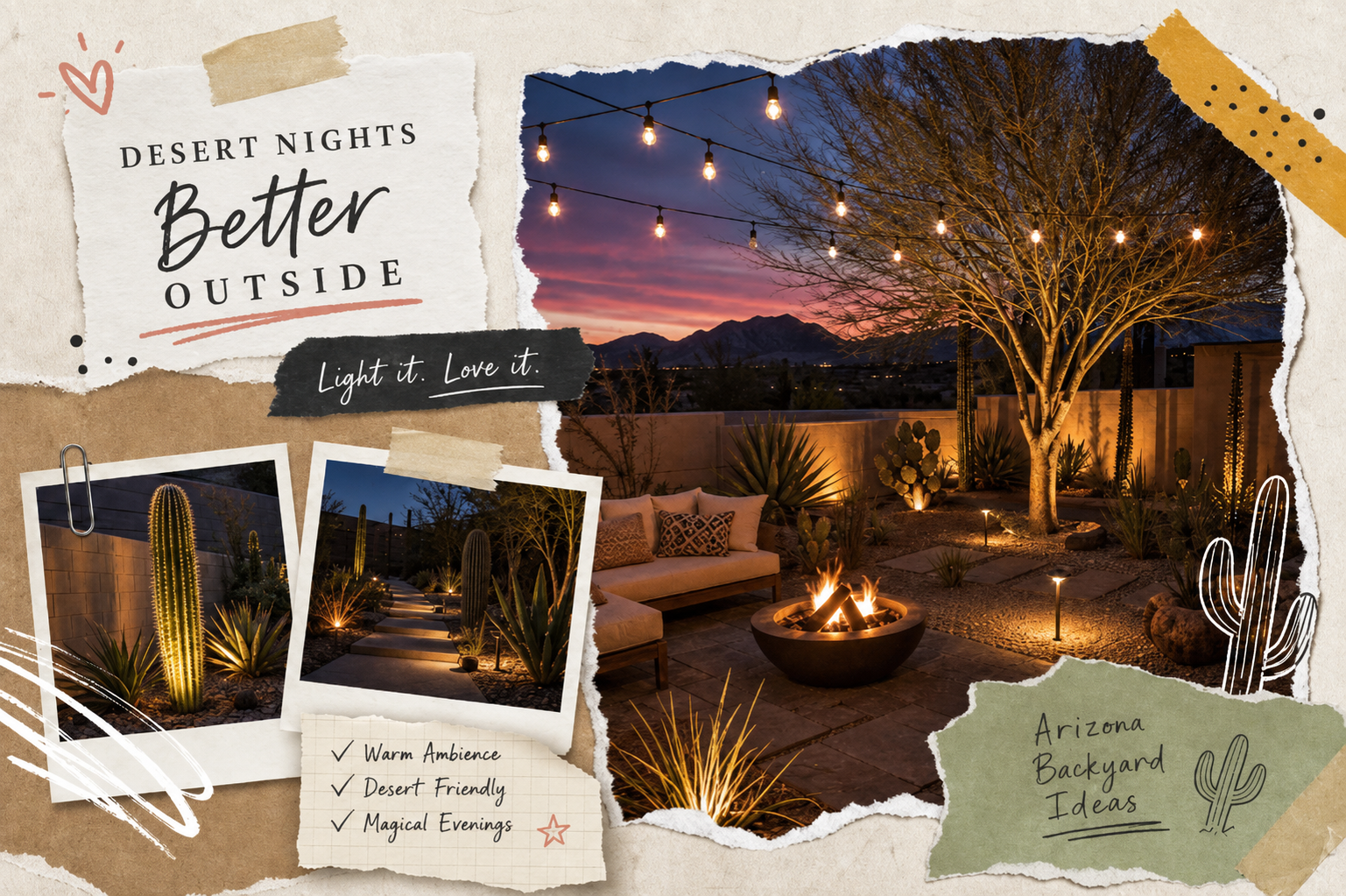
Best Backyard Lighting Ideas for Arizona's Desert Style Around 7 p.m. in August, something shifts in a Phoenix backyard. The temperature drops fifteen degrees in an hour, the sky turns deep indigo above the mountains, and suddenly the yard isn't just a yard anymore. It's where you actually want to be. For most Arizona homeowners, good backyard lighting, Arizona-specific, desert-aware, properly installed, is what separates that feeling from a wasted evening with a few floodlights and a string of lights bought at a hardware store three summers ago. Generic lighting advice doesn't account for the desert. It doesn't mention that cheap, non-UV-stabilized plastic fixtures commonly degrade within a few seasons under direct Phoenix sun, or that certain colors of light make a saguaro look like it belongs in a parking lot, or that your HOA may have opinions about what you install before you ever flip a switch. Good backyard lighting in Arizona is a different discipline than backyard lighting anywhere else. It requires desert-specific fixtures, the right color temperatures for native plants, and someone who understands that the evening hours are the whole point of living here. At Luzazul Lighting, we've spent over 12 years designing outdoor lighting systems across Phoenix, Scottsdale, Chandler, and the surrounding metro. What follows is the practical guide we wish existed when clients first call us: what to light, what fixtures survive the climate, what it actually costs, and how to find someone worth hiring. Arizona backyard lighting for pools: ideas that make desert nights unforgettable The pool is the anchor of most Arizona backyards, and it's almost always underlit after dark. During the day, it's the centerpiece. By 8 p.m., it's usually just a dark shape in the yard. The right lighting changes that completely, and it doesn't take much to get there. Underwater LED options and what color actually looks good Submersible LED fixtures come in two main configurations: fixed warm white and color-changing RGB. For most residential installs, warm white around 2700K is the better choice . It looks polished, it complements the green-grey tones of the surrounding desert, and it doesn't turn your pool into a nightclub every time you have people over. RGB color modes have their place for entertaining, but they're a secondary feature, not the foundation. LED pool fixtures also last significantly longer than the older halogen options, which matters in a high-heat climate where you don't want to be replacing hardware every two years. Perimeter lighting that defines the pool without overdoing it Low-voltage path lights and recessed deck fixtures along pool edges serve two functions: safety and visual definition. Core drill recessed lighting, where fixtures are set flush into the concrete deck, creates a clean, modern edge without exposed hardware that warps and fades under Arizona sun. For fixture ratings near water, use pool-rated or UL-classified underwater fixtures for anything submerged; for wet or monsoon-exposed locations around the deck, aim for IP66 to IP67 depending on exposure level. Anything below that isn't specced correctly for the application. The most common mistake on pool perimeters is too many lights placed too close together. A few well-placed, properly aimed fixtures create more drama than a dozen cheap path lights scattered at random intervals. Patio ambiance: string lights, recessed fixtures, and the case for restraint The covered patio is where Arizona homeowners actually live in the evenings. Getting the lighting right here matters more than anywhere else on the property, and the most important principle is layering rather than flooding. Bistro string lights: the fastest patio transformation available Bistro string lights are the fastest way to make a flat, forgettable patio feel intentional. For covered concrete patios, the most reliable setup uses concrete-anchored corner poles, a stainless steel support cable, and warm LED S14 Edison-style strands clipped to the cable. The support cable carries the load and prevents sag; without it, the strand droops, the bulb sockets take the tension, and the whole thing looks sloppy within a season. A GFCI outlet with an outdoor timer completes the setup. 2700K to 2200K is the right color temperature here , warm enough to feel like an evening, not a work site. Core drill lighting for a polished, minimal look For homeowners who want a cleaner aesthetic on newer builds with large covered patios, core drill lighting is worth serious consideration. It involves drilling into concrete or masonry to set flush-mount fixtures, which eliminates exposed surface hardware entirely. The result looks intentional and architectural rather than added-on. It's popular on newer Phoenix-area properties precisely because those builds often feature large, minimalist concrete patios where surface-mounted fixtures look out of place. Why brightness restraint matters in the desert In Arizona, restraint in brightness is both an aesthetic and a practical choice. Keeping color temperatures in the 2700K to 3000K range preserves the feel of a desert evening and keeps the patio intimate rather than stadium-lit. For managing heat output, the bigger lever is wattage, choose efficient LEDs with lower wattage ratings rather than relying on color temperature alone. This approach also keeps you on the right side of HOA rules and dark-sky ordinances, which are more specific than most homeowners realize. Lighting desert plants and natural features the right way Desert landscaping has its own visual logic: big architectural shapes, negative space, and strong texture. Lighting it well means working with those qualities rather than ignoring them. Uplighting saguaros, agave, palo verde, and ocotillo Of all the native plants worth uplighting, saguaro and ocotillo produce the most dramatic results at 2700K. The saguaro's vertical ribbing catches warm light in a way that cool white completely flattens. Ocotillo's tall cane-like stems create strong shadow lines and a striking architectural silhouette. Palo verde trees respond well to warm light that brings out their structure without washing out the airy canopy, and agave works beautifully for low-angle accent lighting with its rosette form and leaf texture. Warm amber LEDs at 2700K or lower are widely recommended by Arizona dark-sky groups and landscape lighting professionals for permanent landscape fixtures, and the visual results on native plants back that guidance up. Path lighting and amber LEDs for desert gardens and nocturnal wildlife Low-profile brass or copper bollard lights blend into decomposed granite and gravel paths without looking suburban. The goal is to frame the desert garden beds without cluttering them. Path lights in a xeriscaped yard should feel like they belong there, not like they were imported from a cookie-cutter lawn in Ohio. Spacing matters: every eight to ten feet is usually enough to define a path without creating a runway effect. Properties near desert preserves have an additional reason to choose warm amber LEDs. Arizona has a genuine dark-sky culture, and warm, low-output amber light reduces disruption to nocturnal wildlife, a detail that becomes obvious once you're living near a preserve and can see the difference firsthand. Desert-ready fixtures: what actually survives Phoenix heat and sun Material selection is where most out-of-state lighting advice falls apart. In Arizona, the wrong fixture doesn't just look bad after a few years. It warps, cracks, or fades within a single full sun cycle. The only materials worth considering Solid brass and copper are the gold standard for desert landscape lighting. They handle high ambient temperatures, resist UV degradation, and develop a patina over time rather than deteriorating. Powder-coated aluminum is the best mid-range option, lightweight and corrosion-resistant with a finish that holds up to UV exposure. Stainless steel is a reliable choice where extra durability is a priority. When it comes to plastic housings: avoid inexpensive, non-UV-stabilized plastic entirely. If polycarbonate is on the table, it should be explicitly UV-stabilized and heat-rated for desert exposure, otherwise it's the one material category every experienced installer in the Phoenix metro has seen fail. This isn't a preference; it's what experienced installers here have seen firsthand. LED specs that actually matter in the desert For exposed fixtures, IP65 is the minimum acceptable rating. For anything near water or in monsoon-exposed locations, IP66 or IP67 is the correct spec. Warm LEDs between 2700K and 3000K align with the shielding-focused dark-sky guidelines that apply across most of the Phoenix metro, note that Phoenix's municipal code emphasizes fully shielded, downward-directed fixtures rather than a specific color temperature limit, while Pima County also caps residential fixtures at 1,600 lumens per fixture. Choose fixtures with tempered glass lenses rather than polycarbonate covers; tempered glass handles heat and sun exposure far better over time. HOA rules and dark-sky ordinances you need to know before you install Phoenix requires shielding or filtration for several lamp types unless the fixture has an automatic shutoff and isn't used from 11 p.m. until sunrise. The practical translation: fully shielded, downward-directed fixtures on timers keep you compliant without any additional effort. Pima County has a stricter residential rule: 1,600 lumens per fixture is the cap, and anything above that threshold must be fully shielded to prevent light trespass onto neighboring property. For both markets, the common HOA standard is no visible bulb from neighboring property and no light crossing the property line. Backyard lighting costs in Arizona: what Phoenix-area projects actually run Most homeowners underestimate costs, especially when desert-specific fixtures are involved. Here are the 2026 Phoenix-area averages organized by project scale: Small backyard installs: $1,500 to $2,500 Mid-size projects: $2,500 to $4,500 Larger or high-end installs: $4,500 to $6,000 or more Materials typically run $585 to $3,900 and labor $736 to $3,220, depending on scope. Per-fixture costs, including the fixture, wire, transformer, and installation, land around $150 to $350. Underwater pool lighting is its own category: replacing a single existing LED runs $450 to $800 installed, while adding a new underwater fixture costs $700 to $1,500, and multi-fixture pool overhauls can reach $1,200 to $3,500 or more depending on wiring access and controls. How much does backyard lighting in Arizona cost for DIY vs. pro installs? Low-voltage DIY kits exist at every big-box store in the Phoenix metro. They use plastic fixtures that fail fast in desert heat, and the results rarely match what a skilled installer achieves. A professional brings design judgment, proper wire burial depth, and transformer sizing that a weekend project almost always skips. The fixtures that survive a Phoenix summer cost more than what comes in a kit. The labor cost is real, but so is the cost of replacing cheap fixtures two years from now and starting over. How to hire an outdoor lighting installer in Arizona: questions worth asking The installer you hire matters as much as the fixtures they use. A good Phoenix-area installer should know dark-sky ordinances, common HOA rules, and how to spec fixtures for desert heat without being prompted. Ask how long they've worked in the Phoenix metro and whether they have specific experience with xeriscaped or pool-centric properties. Experience with local conditions isn't a bonus; it's the baseline. A reliable quote should cover fixture type and brand, transformer sizing, wire gauge and burial depth, warranty terms, and a clear breakdown of labor. Vague proposals that lump everything into one number are a red flag. Ask whether the quote includes a design layout and whether the installer will walk the property with you before finalizing anything. The layout conversation reveals a lot about how someone approaches the work. At Luzazul Lighting, we offer an on-site demo before any commitment. That means you see how the fixtures actually look on your specific property at night, against your actual plants and architecture, before signing anything. Most contractors skip this step entirely. For a decision that affects how your home looks every single evening, that certainty is worth a great deal. It's one of the reasons clients who call us for a quote often describe it as a different experience than what they expected. The evening is the point Arizona backyard lighting isn't primarily about security or resale value, though it delivers both. It's about making the most of the outdoor hours that desert living is actually built around. The evenings from September through May are genuinely extraordinary here, and a well-designed lighting system extends every one of them. The framework is straightforward: anchor the pool with properly rated underwater and perimeter lighting, layer the patio with warm bistro light or recessed fixtures, accent native plants with warm amber uplighting, use brass or powder-coated aluminum fixtures rated IP65 or higher , and keep color temperatures at 3000K or below. Get the material choices right, and the system lasts. Get the design right, and the yard becomes the best room in the house after dark. If you're ready to see what your specific property can look like at night, reach out to Luzazul Lighting for an on-site consultation. We'll walk your yard with you, demo the fixtures before you commit to anything, and design a system built for the desert, not adapted from somewhere else.
By Dennis Lozano August 14, 2026
This is a subtitle for your new post
Pathway Lighting
March 22, 2026
Discover why Phoenix homebuyers notice evening pathway lighting first, boost safety, ambiance, and curb appeal with smart outdoor lighting design and installation.
Backyard
March 22, 2026
Create unforgettable backyard cinema with lighting tips and outdoor audio in Phoenix, plus setup ideas for clear sound and cozy ambiance
Garden Lighting
March 22, 2026
Discover how garden lighting in Phoenix highlights desert blooms, improves safety, and creates cozy ambiance for memorable evenings outdoors
Outdoor Lighting
March 21, 2026
Learn the best fixture materials, lens options, and color temperatures for Phoenix outdoor lighting that stays bright and reliable in 115°F heat.
garden lights
March 18, 2026
Discover subtle upgrades and design tips for garden lighting in Scottsdale to highlight paths, plants, and patios with a warm, inviting glow.
audio zoning
March 18, 2026
Learn how to set up outdoor audio in Phoenix with multi zone amps and app controls for patio, pool, and firepit zones while keeping neighbors happy.
motion sensing
March 18, 2026
Compare motion sensing and dusk to dawn pathway lighting in Phoenix to boost security, reduce glare, and meet dark sky friendly settings without harsh hotspots.